Buying an exterior door in South Florida is not like buying one anywhere else in the country. Between the Florida Building Code, county-level requirements, and a wall of acronyms — HVHZ, NOA, DP, TAS — most homeowners sign off on a door without really knowing what they bought. That matters, because the wrong paperwork can fail your inspection, and the wrong door can void your windstorm insurance credit. Here is the plain-language version of what the code requires and what you should demand from any supplier.
First: Are You in the High-Velocity Hurricane Zone?
The Florida Building Code designates Miami-Dade County and Broward County as the High-Velocity Hurricane Zone, or HVHZ. This is the strictest wind-borne debris standard in the United States, and it applies to every exterior opening — doors included. If your project is in Miami, Hialeah, Fort Lauderdale, Hollywood, Pompano Beach, Coral Springs, or Deerfield Beach, you are in the HVHZ.
Palm Beach County — Boca Raton, West Palm Beach, Delray Beach — sits outside the HVHZ but still falls within wind-borne debris regions with high design wind speeds. The requirements are serious there too; they are simply administered under the statewide code rather than the HVHZ chapter. Always confirm the specific requirement with your local building department, because municipalities can and do adopt stricter local amendments.
Impact-Rated vs. Shutter-Protected: Two Legal Paths
The code does not force you to buy impact glass. It requires that the opening be protected. You can satisfy that in one of two ways: install an assembly that is itself impact-rated, or install a non-impact assembly plus an approved shutter, panel, or screen system. Both are legal. They are not equally practical.
- Impact-rated door: permanent protection, nothing to deploy before a storm, and it typically qualifies for a windstorm insurance mitigation credit
- Non-impact door + shutters: lower initial cost, but requires someone physically present and able to install panels before every named storm
- Shutters over a signature front entry are rarely acceptable aesthetically on a high-end home
- Insurance carriers generally require documented opening protection on all openings — one unprotected door can disqualify the whole credit
NOA vs. Florida Product Approval: The Document You Must Receive
This is where most buyers get lost. A door is not "hurricane rated" because a salesperson said so. It is rated because the specific assembly — slab, frame, glass, hinges, hardware, and anchoring — was tested as a unit and issued an approval document. There are two of them in Florida.
- Miami-Dade NOA (Notice of Acceptance) — issued by Miami-Dade County Product Control, accepted throughout the HVHZ and widely recognized as the toughest approval in the country
- Florida Product Approval (an "FL" number) — the statewide approval administered by the Florida Building Commission, valid across Florida when the approval covers HVHZ use
- Both documents list the exact tested configuration: maximum size, glazing type, anchor pattern, and the design pressures the assembly is approved for
- The approval is only valid if the door is installed exactly as the document specifies — substitute the anchors or oversize the unit and the approval no longer applies
What the Testing Actually Involves
HVHZ approval is earned through a sequence of protocol tests, referenced in the code as TAS standards. In the large missile impact test, a nine-pound piece of lumber is fired at the assembly at roughly fifty feet per second. The assembly must not be penetrated. It is then subjected to thousands of cycles of positive and negative pressure that simulate a storm pushing and pulling on the opening for hours — because a door that survives the impact but then fails under pressure cycling has still let the storm inside.
That second part is the reason breach matters so much. Once wind enters a sealed house through a failed opening, internal pressure spikes and can lift the roof structure from the inside. The front door is not a cosmetic decision in Florida — structurally, it is part of the building envelope.
Design Pressure: The Number That Is Specific to Your House
Design Pressure, written as DP or as separate positive and negative values, is the wind load the assembly is rated to withstand. The required number is not universal — it is calculated for your building from the design wind speed at your address, the height of the opening, the exposure category, and whether the door sits in the middle of a wall or near a corner. Corners and higher floors see substantially higher loads than a sheltered mid-wall opening.
This is why a door that was approved for one project may be rejected on another. Your architect, engineer, or permit drawings will specify the required DP for each opening. A competent supplier matches the approved assembly to that number before quoting, not after the door is already built.
Can a Custom Wood Door Be Hurricane Rated?
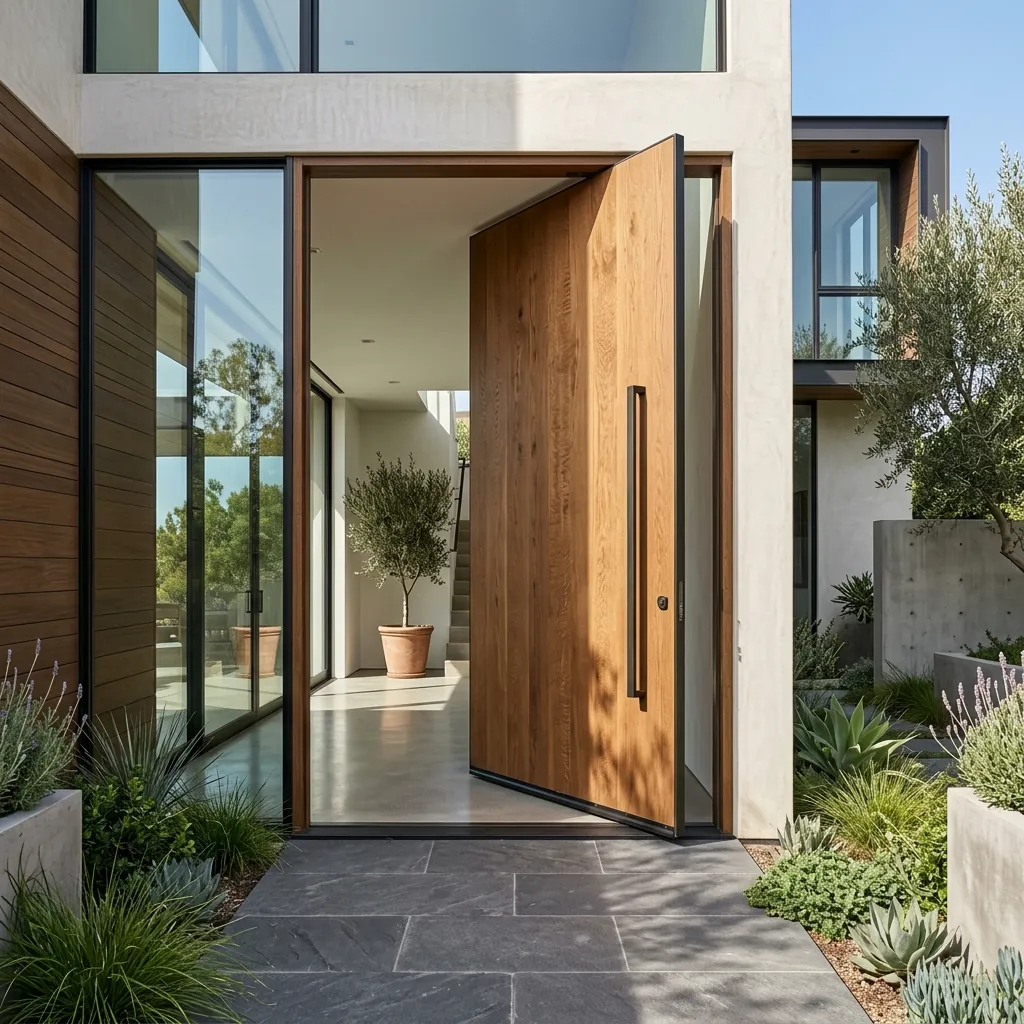
Yes — and this is the question we get most often, usually from homeowners who assume they must choose between code compliance and a real wood entry. You do not. Impact-rated assemblies are available in configurations that carry genuine hardwood cladding, deep stile-and-rail profiles, oversized pivot panels, and custom glass. The engineering lives in the core, the reinforcement, the laminated glazing, and the anchoring; the visible surface is still the craftsmanship you actually wanted.
The constraint is that you design within the tested envelope. Maximum dimensions, glazing area, and hardware are fixed by the approval document, so the design conversation has to happen before fabrication — not as a change order afterward. At GNG Complete Carpentry we work from the approved configuration outward, which is why we ask for the opening dimensions and the required design pressure on the very first call.
The Checklist to Use Before You Sign
- Ask for the NOA or FL approval number for the exact assembly being quoted — not for a similar model
- Confirm the approved maximum size covers your actual rough opening
- Confirm the approved design pressure meets or exceeds the DP required by your permit drawings
- Confirm the installer will use the anchor type, spacing, and substrate specified in the approval
- Ask whether the frame and threshold are part of the same approval as the slab
- Keep the approval documents — your insurer will ask for them when you claim the mitigation credit
None of this is meant to replace your permit process. Codes are amended, and your local building department is the final authority on what your specific address requires. But walking into that conversation knowing what an NOA is, and what design pressure your opening needs, is the difference between specifying a door and being sold one.
FAQ
Frequently Asked Questions
Do I need impact-rated doors in Miami-Dade or Broward County?
Miami-Dade and Broward counties are the High-Velocity Hurricane Zone (HVHZ) under the Florida Building Code, so every exterior opening must be protected. You can meet that either with an impact-rated door assembly or with a non-impact door plus an approved shutter or panel system. Impact-rated doors are the more common choice because they need no deployment before a storm and typically qualify for a windstorm insurance mitigation credit. Confirm the exact requirement for your address with your local building department.
What is a Miami-Dade NOA and why does my door need one?
A Notice of Acceptance (NOA) is the approval document issued by Miami-Dade County Product Control certifying that a specific door assembly passed the required impact and pressure-cycling tests. It lists the maximum approved size, glazing, anchor pattern, and design pressures. Without an NOA — or an equivalent statewide Florida Product Approval "FL" number — an inspector has no basis to approve the installation.
Can a custom wood entry door still be hurricane rated?
Yes. Impact-rated assemblies are available with genuine hardwood cladding, deep stile-and-rail profiles, oversized pivot panels, and custom laminated glass. The structural performance comes from the core, reinforcement, glazing, and anchoring, so the visible craftsmanship is preserved. The design simply has to stay within the dimensions and glazing area covered by the approval document, which is why the specification must be settled before fabrication begins.
What design pressure (DP) do I need for my exterior door?
There is no universal number. Design pressure is calculated for your specific building from the design wind speed at your address, the height of the opening, the exposure category, and the position of the opening on the wall — corners and upper floors carry substantially higher loads. Your permit drawings will state the required DP for each opening, and the approved door assembly must meet or exceed it.
Does an impact-rated door lower my homeowners insurance in Florida?
Documented opening protection is one of the mitigation features Florida insurers evaluate on a wind mitigation inspection, and it commonly reduces the windstorm portion of the premium. The credit generally requires that all openings be protected, so a single unprotected door can disqualify it. Keep the NOA or FL approval documents — your carrier will ask for them. Actual credits vary by carrier and policy.